Prevent the Event—What went wrong for Sen Lindsay Graham and how to prevent
Best exercises for BP control; Take care of your gums to protect your valves; another pesticide prob; statins are low risk --new calculator

1. Prevent the Event—What went wrong for Sen Lindsay Graham (Roizen Rule for a Younger YOU #1 story this week)
2. Best Exercise for Blood Pressure Control (Wellness 4Play#1 story this week)
3/ . Roizen Rule for a Younger You #2 story this week: Scientists discover a hidden heart valve risk linked to gum disease
4. Odd Omega #1 story this week: Another Pesticide Problem???—Wash em well
5. Longevity is the Next Disruptor Story #1 this week: New calculator reveals whether you should really worry about statin side effects, and more than 98% shouldn’t
1. Prevent the Event—What went wrong for Sen Lindsay Graham (Roizen Rule for a Younger YOU #1 story this week)
Sen. Lindsey Graham, R-S.C., died Saturday night at age 71 from an aortic dissection, a rare but life-threatening medical emergency that requires immediate treatment.
An aortic dissection occurs when a tear develops in the inner layer of the aorta, the body’s largest artery. Blood rushes through the tear, forcing the layers of the artery wall apart. If the tear extends through the outer wall of the aorta, the condition is often fatal.
Aortic dissection is an uncommon condition that most often affects men in their 60s and 70s, and is usually forecast in advance. What went wrong? Did he not get medical exams that spotted it…
According to Gemini and CBS: AI Mode Conversation:
There is no public medical record or official confirmation indicating whether Senator Lindsey Graham received an evaluation for his aortic size prior to his death.
Following his sudden passing on July 11, 2026, his office and the Washington D.C. Medical Examiner’s Office released preliminary autopsy findings. These findings attributed his death to an aortic dissection brought on by arteriosclerotic cardiovascular disease (hardening of the arteries). However, specific details regarding his prior medical screenings, private imaging results, or preemptive care tracking his aorta size have not been disclosed to the public”
Shame on his docs and/or him if they didn’t exam him for it, or the Sen himself if he didn’t get that screening test at least every two years. Hopefully you will—that is the take home as I wrote in the June 4th 2026 blog—excerpted here:
“1. Travel and a 5th TPE; grandkids make you younger Ping Pong and Pickleball Toronto has grown up big league but they visit Buffalo for its joys. Prevent the first event……
There were great questions for the assembled and on-line audiences at the talks—the Clinic has really engaged and bright,educated and motivated patients and staff. One question from a Cleveland Clinic Canada doc was do I do different things for primary (before an event) versus secondary prevention (to prevent another event after one or more events has/have occurred). No I responded..I try to help the patient prevent all events—I don’t want any patient to have any event—so I try to have the patient do lifestyle maneuvers and take meds or supplements to eliminate all risk for cardiac, neuro, immune--cancer here) and metabolic diseases, as long as the risk reduction has substantially more benefit than risk. No patient should have to be in a hospital or rehab (or morgue) because I waited to suggest something that could prevent a first event as well as a second. Why not prevent the first if possible to do so?
Speaking of prevention:
2.Preventing Dementia with BP control..what meds are you most likely to stay with—have only beneficial lifestyle side effects.
High blood pressure (HBP) is a the major cause of heart attacks, kidney failure, death and dementia. Not just in the USA does it cause more disability than any other single factor but in all developed countries, despite the fact that we know how to prevent and treat the condition with lifestyle choices and medicines.
Unfortunately, antihypertensive medicines aren’t universally well-received. In Veterans where the medicine is free (by the way the Veterans studies in the 1960’s established great benefits from BP lowering drugs, only 66% so prescribed walked the 1-2 blocks down the hall to get their prescription filled, and 50% of those that filled their prescritptions stopped the drug within 6 months. Another study (https://www.medrxiv.org/content/10.64898/2026.04.28.26351691v1) (not in Veterans—I am partial since I am a Veteran) found 41% of folks stopped taking their prescribed HBP medicines because of perceived side effects. And that is a shame as we have about 150 approved meds for this condition, and you can have almost any side effect or none you want—see below. But between 41 and 66% in these two studies didn’t get the benefits because they didn’t take their pills.
So researchers decided to figure out which antihypertensives folks are most likely to stick with. Their review in JAMA Network Open (https://jamanetwork.com/journals/jama/fullarticle/2849512And editorial, https://jamanetwork.com/journals/jama/fullarticle/2849519
https://tampacardio.com/the-dangers-of-stopping-high-blood-pressure-medicine-without-supervision/) looked at 716 studies and found that folks were most likely to discontinue taking calcium channel blockers, combos of beta-blockers and ACE inhibitors and of beta-blockers plus thiazide diuretics. However, all regimens that contained ARBs (angiotensin II receptor blockers) were more likely to be continued.
Angiotensin II receptor blockers (ARBs) are medications that relax blood vessels. The most commonly prescribed standalone ARBs are losartan (Cozaar), valsartan (Diovan), and olmesartan (Benicar).
Commonly prescribed standalone ARB medications include:
Azilsartan (Edarbi)
Candesartan (Atacand)
Eprosartan (Teveten)
Irbesartan (Avapro)
Losartan (Cozaar)
Olmesartan (Benicar)
Telmisartan (Micardis)
Valsartan (Diovan)
I particularly like Telmisartan (Micardis) and Valsartan (Diovan). The former also decrease inflammation in your body, while the latter’s side effect is an increase in libido which a lot of my female (as well as male) patients like. And data indicate decreased inflammation and increased decrease the risk for dementia.
Here’s the benefit from one of the first Veteran’s studies—it was a randomized double blind controlled study of Vets—the gold standard of clinical trials—average age of the Vets was 53 when they started the study—with what we call less than optimal BP reducing drugs now. Yet within 6 years, those that received the drugs had only 6% disability or death rate as opposed to 36% in the control untreated men. Six fold reduction in disability and with BP drugs and target endpoints we now consider less than perfect .
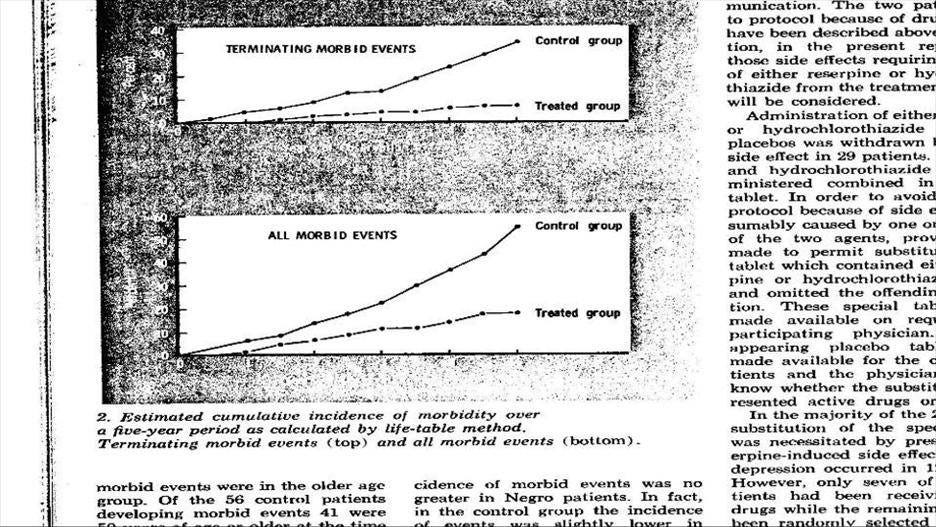
Now, your case of hypertension (along with other chronic conditions) may call for an antihypertensive or combination that’s less tolerable. If you’ve stopped taking your meds (I bet if you have, you haven’t told your doc), have a conversation about what side effects you want –we have drugs that decrease libido as well as increase it, and drugs with no or many positive side effects like decreased inflammation—and what you might stick with that targets your special lifestyle needs….”
Now back to Sen Graham and what is an aortic dissection and why you should be screened for a expanding aorta every two years or more often with a non-invasive ultrasound test:
If you wait till symptoms develop, it may be too late—50% die before getting to or out of an emergency department, and 50% of the rest never fully recover – much more difficult to manage after an event--
Aortic dissections usually cause sudden, severe pain in your chest or shoulders or abdomen or groin. Such pain is often described as tearing or ripping, and can soon be accompanied by shortness of breath, sudden vision changes, difficulty speaking, or weakness or leg pain or difficulty walking.
Your aortic wall has three layers. When the inner layer tears it allows blood to flow between the layers and separate them—that is the dissection, and blood between the walls cannot be returned to the heart, and thus the heart cannot pump that blood to the rest of the body. If that blood escapes the aorta or is a big enough collection in the aortic walls, the heart cannot pump enough blood to the brain and to itself to survive.
Such dissections can usually be prevented. If one has an aortic aneurysm on non-invasive ultrasound scan, and starts expanding beyond certain limits, your aorta becomes more likely to tear or rupture. Small aneurysms are often monitored with regular non-invasive ultrasound imaging and managed by controlling blood pressure, lipids, stress, and eliminating unforced errors like vaping, and smoking. Larger aneurysms or those at high risk of rupture may require surgery or a minimally invasive endovascular repair.
That’s why shame on his docs and/or him—cause that preempts the event.
Risk factors for that aortic aneurysm include high blood pressure, smoking, and certain inherited connective tissue disorders—is that what killed his mom? More screening is done more often and more to prevent the event.
Get the point you must get proper screening and treatment of risks—only you with your doc can prevent the event.
2. Best Exercise for Blood Pressure Control (Wellness 4Play #1 story this week)
Everyone from yours truly and the other experts at 4YOUngevity.com to the CDC enthusiastically recommends physical activity regularly done to prevent and control high blood pressure. But half of Americans(https://www.aha.org/news/headline/2026-04-07-cdc-finds-nearly-half-us-adults-get-recommended-amount-physical-activity)don’t come close to getting the suggested minimum level of physical activity (150-300 minutes a week). There are a number of reasons for that—but lack of time or money to go to the gym, join a team or buy equipment account for some of the obstacles.
Guess what? You have the time and free equipment you need to achieve an effective workout and keep your blood pressure healthy: eight minutes and YOU!
Research published in the British Journal of Sports Medicine (https://bjsm.bmj.com/content/57/20/1317#supplementary-materials) looked at 270 randomized, controlled studies and found that while aerobics, HIIT and dynamic resistance training are all effective ways to help reduce your resting systolic (the upper number) and diastolic (the bottom number) blood pressure, isometrics are the most effective—by a significant degree.
And all it takes is doing three to four sets of two-minute exercises like wall squats, chest presses, and planks.
I suggest you do isometrics every other day and increase over time to 10 minutes each session. Also important to know: As you do isometrics, you want to make sure you don’t strain or hold your breath—concentrate on breathing slowly in and out, focus on tightening a specific muscle or group of muscles, and don’t move your joints (https://www.mayoclinichealthsystem.org/hometown-health/speaking-of-health/isometric-exercise-and-blood-pressure).
And do double resistance breathing as we discussed in a previous blog—it decreases BP as much as any one medication. For more info on preventing and treating HBP, check out my last book, The Great Age Reboot, or even better preorder the next one YOU: Getting Older, the Owner’s Manual to the Golden Years. (please do preorder it—preorders govern IMHO how much publicity the book will get and this is the next one in the YOU series and a great one with cartoons returning—shameless plug):

3. Roizen Rule for a Younger You #2 story this week: Scientists discover a hidden heart valve risk linked to gum disease
I never flossed till my mid-40’s (bad on me) till my dentist—Steve Potashnick , now retired—said: “Mike—only floss the teeth you want to keep”. But there is more to buttress: only floss if you want your brain, heart arteries, metabolism and now heart valves to stay young (ScienceDaily, 13 July 2026.<www.sciencedaily.com/releases/2026/07 /260713000751.htm>.)
Bacteria that cause gum disease may do more than damage your teeth. Porphyromonas gingivalis (P. gingivalis), bacteria linked to gum disease may drive the development or worsening of calcific aortic valve stenosis (CAVS) by triggering inflammation and calcium buildup in that and other heart valves.
The early findings suggest that keeping gums healthy could play a role in reducing the risk of this serious heart condition.
CAVS, a common and potentially life threatening heart valve disorder, develops when the aortic valve gradually becomes thicker and more calcified, making it harder for blood to flow from the heart to the rest of the body. As CAVS worsens, however, it can lead to fatigue, chest pain, shortness of breath, fainting, heart failure, and in some cases premature death. For people with severe disease, TAVR (closed) or open valve replacement surgery is currently the standard treatment.
Cardiovascular Diseases, the Chinese Academy of Medical Sciences and Peking Union Medical College all in Beijing.
Porphyromonas gingivalis (P. gingivalis), is known to play a major role in periodontal disease by causing gum inflammation and the destruction of gum tissue. Previous research has also linked P. gingivalis to widespread inflammation throughout the body and an increased artery plaque buildup, coronary artery disease, and dementia. The current researchers supplemented these human data with animal—mouse-- data that buttressed their conclusion— repeated exposure to live P. gingivalis caused the bacteria to accumulate in the aortic valves of mice, leading to greater valve calcification and symptoms of aortic stenosis. Preventive antibiotic treatment reduced these effects. The researchers also found that P. gingivalis activated interleukin-1 beta (IL-1b), an inflammation promoting protein produced mainly by immune cells-- genetically deleting IL-1b significantly reduced valve calcification and disease symptoms, even when P. gingivalis was present.
This study adds to the growing evidence that periodontal disease can cause heart, metabolic and brain disorders. The solution is also key—floss or use a pressurized “Water Pik” devise at least daily, and see a dental professional at least three times a year.
4. Odd Omega #1 story this week: Another Pesticide Problem???—Wash em well
We reported about the hazard (and solution to it) of the pesticide used on golf courses till it runs out (banned for sale in the USA for any purpose since 6 30 26) implicated in a 3.5 fold higher rate of Parkinson’s disease among those with homes on golf courses(MichaelFRoizenMD.substact.com blog of 7 3 26). Now comes a more common issue with some pesticides now used on produce and whole grains. This is the conclusion from a question the researchers posed: Why are healthy young non-smokers developing lung cancer? (ScienceDaily. ScienceDaily, 13 July 2026. <www.sciencedaily.com/releases/2026/07/260712011758.htm>.) This finding is especially disturbing since USA smoking rates have declined from about 28% in the mid 1990’s to under 12.5% now ( under 0.2 % now from 21% in 2005 among Cleveland Clinic employees as documented by urine screening as we incentivized wellness among our employees).
To better understand why, researchers launched the Epidemiology of Young Lung Cancer Project. The study included 187 people diagnosed with lung cancer by age 50. Participants provided information about their diet, smoking history, demographics, and cancer diagnosis. On average, Participants consumed 4.3 daily servings of dark green vegetables and legumes and 3.9 servings of whole grains. By comparison, the typical U.S. adult consumes 3.6 servings of dark green vegetables and legumes and 2.6 servings of whole grains each day.
According to this research, commercially grown (non-organic) fruits, vegetables, and whole grains generally contain high levels of pesticide residues. Women under 50 who have never smoked but who ate more fruits, vegetables, and whole grains than their male counterparts are developing lung cancer more often than men in the same age group.
The result suggests pesticides on otherwise conventionally grown produce --healthful foods-- may explain the rise of lung cancer in younger non-smokers, no-vapers.The researchers emphasize that the foods themselves are not believed to be the problem. Instead, they suspect pesticide exposure could help explain the surprising pattern.
They stress that the findings are preliminary and require further studies before any conclusions can be drawn.
Suppoting this concer is another study. Prior research showed that agricultural workers with long term pesticide exposure experience higher rates of lung cancer, adding support to the hypothesis.
The take home from this preliminary research is not preliminary it is a do it to Prevent the Event—buy organic if you can, but in any case (even with “organically grown”) and especially with foreign origin produce, wash all produce, especially berries but all fruit and vegetables four times in a salad spinner—the first time with a 1 to 3 ratio of white wine vinegar and water, and the next three (spinning to near dry each) in cold water.
5. Longevity is the Next Disruptor Story #1 this week: New calculator reveals whether you should really worry about statin side effects, and more than 98% shouldn’t
Other docs at the Cleveland Clinic send me patients that they can’t get to take statins to control their apolipoprotein B or LDL cholesterol levels…in the hope I can motivate them to do so—see that prior blog—YOU Get a STATIN AND A GLP-1, AND YOU Get a STATIN AND A GLP-1!!, Jan 4th, 2026. Well in addition to the predominantly beneficial side effects of both statins and GLP-1’s, there is a calculator you can use to see if you should worry about taking a statin.
Scientists at the University of Oxford have created a calculator that predicts a person’s individual risk of serious muscle disorders from statin medications(The Lancet Digital Health, 2026; 101024 DOI: 10.1016/j.landig.2026.101024). Their analysis found that more than 98% of people who qualify for statins are at low risk for these rare complications, despite widespread concerns about side effects.
However, worries about muscle related side effects often discourage people from starting treatment or lead them to stop taking the medication, even when the potential benefits are substantial. The study found that most (60%) eligible patients are not taking statins, potentially missing important protection against heart attacks and strokes, as well as decreased risk of cancer, osteoporotic fractures, and dementia. –see that prior blog for those data.
The calculator, available through the Oxford University Innovation software store, is based on a model developed and tested using anonymized health records from more than 5.6 million people registered with GP practices across England.
The model analyzes 22 routinely collected health factors to estimate the likelihood of developing a serious muscle disorder over one, five, and 10 years.
The researchers emphasized that their work focuses only on serious muscle disorders that result in hospital admission or death, not the milder muscle aches and pains that some people experience. Previous research has shown that many mild muscle symptoms reported during statin treatment are not actually caused by statins and should not prevent patients from beginning therapy.
The Take Homes:
1. Prevent the Event—the lesson from Sen Lindsay Graham.. Get screened for cardiovascular disease in all its components every year or two at least..all CV disease is at least 80% preventable now,
2. If you have high BP, work with your doc to find a treatment you can live with—again Prevent the Event
3. To help with BP control, do three to four sets of two-minute isometric exercises like wall squats, chest presses, and planks every other day and increase over time to 10 minutes each session-- make sure you don’t strain or hold your breath—concentrate on breathing slowly in and out, focus on tightening a specific muscle or group of muscles, and don’t move your joints. And do double resistance breathing as discussed in a previous blog.
4. Buy organic fruits and veggies if you can, but in any case (even with “organically grown”(and especially with foreign origin produce), wash all produce, especially berries but all fruit and vegetables four times in a salad spinner—the first time with a 1 to 3 ratio of white wine vinegar and water, and the next three (spinning to near dry each) in cold water.
5. Get your LDL or ApoB levels below 70mg/dL to Prevent the event—statins are low risk for 98% of eligible people. Use the Oxford calculator if you worry about taking a prescribed statin.
Thanks for reading,
Mike Roizen, MD, FACP