Longevity Whirlwind
Liz Parrish is amazing

Longevity Whirlwind
1.Whirlwind Longevity Conferences
2. The Fearless, Brilliant and Beautiful Liz Parrish and Longevity
3. The Time course of extinction of gene therapy benefits and
4. Therapeutic Plasma Exchange before gene therapy
5. Dallas Boston Collaborative
6. Wei Wu He
7. The Buck The E2 Gene and its protein
8.. The Shadows
9. A Question for a Reader
10. Fiber
11. Visceral Fat and Menopausal Symptoms
Whirlwind Longevity Conferences
As I reflect on the whirlwind days from last Thursday to the middle of this week, I am not just inspired by the places I’ve been or the people I’ve met, but by the profound innovations shaping the future of human health and longevity. My journey began by lecturing and discussing the current state of longevity research in the serene landscapes of Sundance, Utah, at the Da Vinci 50, a gathering of visionaries dedicated to bridging the daunting 18-year gap between scientific discovery and clinical implementation.
Here, the mission is clear: to provide access to groundbreaking, often overlooked strategies that promise to extend and even reverse the aging process.
In Dallas, I found myself amidst the intellectual fervor of the Boston Collaborative Group, where I delved deep into the 14 pillars of age reversal research. While my previous discussions broadly covered these areas, this time, my focus was sharply honed on therapeutic plasma exchange—a promising frontier in our quest to defy time.
By Sunday, my path led me to Columbia, Maryland, marking a significant milestone: the inauguration of our fourth therapeutic plasma exchange clinic, soon to be enhanced with longevity AI coaching. This pioneering initiative aims to integrate AI-driven insights into a comprehensive suite of age-defying techniques—spanning blood pressure control, hormonal therapies, and gene therapy, to name a few. Our ambition is to roll out these innovations broadly, as our AI systems continue to perform robustly in demonstration clinical application.
The Fearless and Brilliant Liz Parrish
But amidst these broader strides, certain moments stood out. Listening to the fearless Elizabeth Parrish, a trailblazer in gene therapy, was one such instance. In 2015, she boldly pioneered gene therapy on herself, (first patient I think ever on herself) targeting over the last 11 years, genes that enhance muscle mass, telomere length, and brain function.
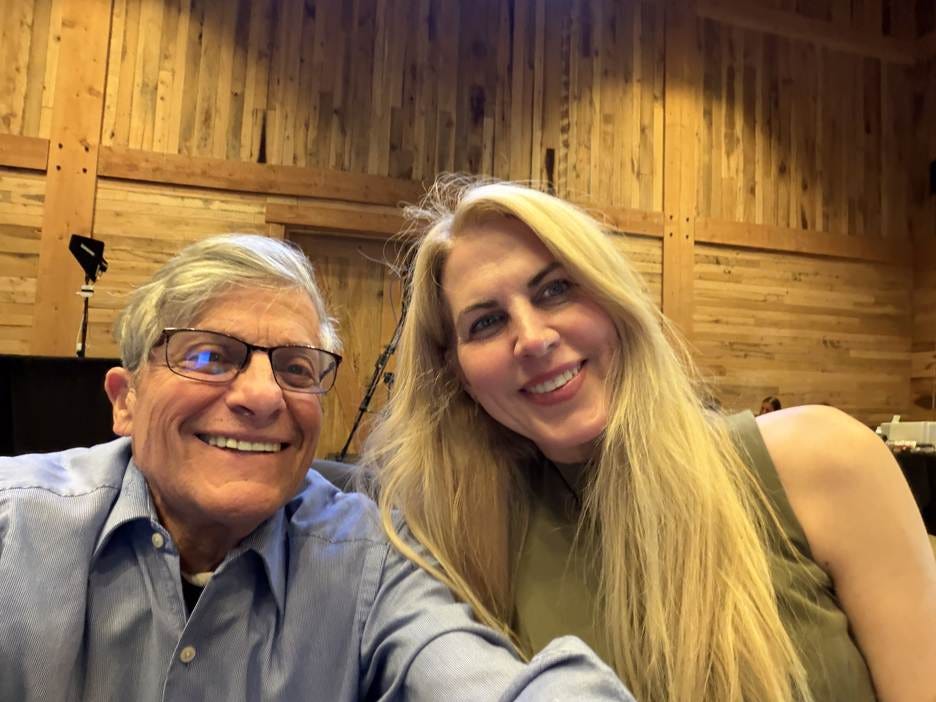
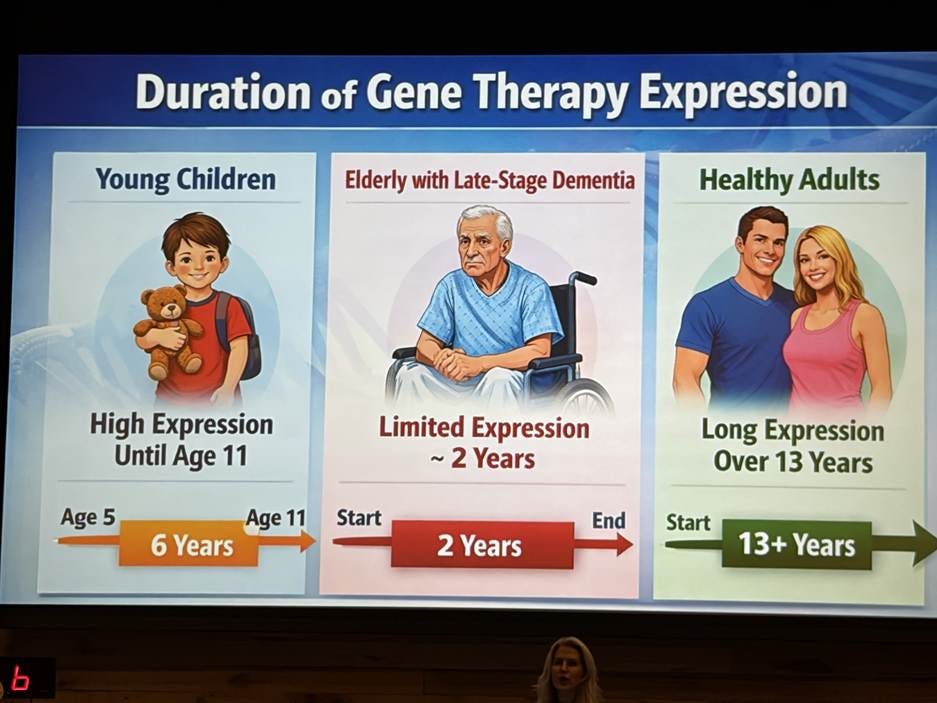
Her company, BioViva Sciences, is now translating these advances to varied age groups, underscoring a nuanced understanding that while middle-aged individuals may require less frequent interventions, the young and elderly benefit more from regular treatments.
Parrish’s personal connection to this mission, driven by her son’s battle with type 1 diabetes, adds a poignant layer to her groundbreaking work.
Wei -Wu He
Equally enlightening was my encounter with Wei He of Human Longevity, whose insights into the dynamic interplay between wellness—slowing the aging process—and longevity—reversing it—provided a holistic view of the current research landscape. Notably, findings from the BrainHQ.com highlight the potential of speed of processing cognitive exercises in delaying dementia by turning on a gene that repairs neurons and increases acetylcholine production in key areas , a revelation echoing the protective effects of the ApoE2 gene in the recent BUCK research release.
The Buck:As we anticipate the Buck Institute’s upcoming Longevity Clinics meeting, set against the picturesque harvest of Napa Valley, the industry’s trajectory is nothing short of remarkable. UBS researchers predict an exponential growth from a $5.3 billion industry in 2023 to a staggering $7 trillion by 2030.
The BUCK’s research
People who carry the APOE2 version of the apolipoprotein E gene are more likely to live to advanced age and are partly protected against Alzheimer’s disease, but scientists have struggled to explain why. A new study from the Buck Institute for Research on Aging, now published in Aging Cell, DOI: 10.1111/acel.70494 offers a mechanistic answer: APOE2 helps human neurons keep their DNA intact and resist becoming senescent, a damaged, dysfunctional state that accumulates with age and contributes to neurodegeneration.
The Shadows
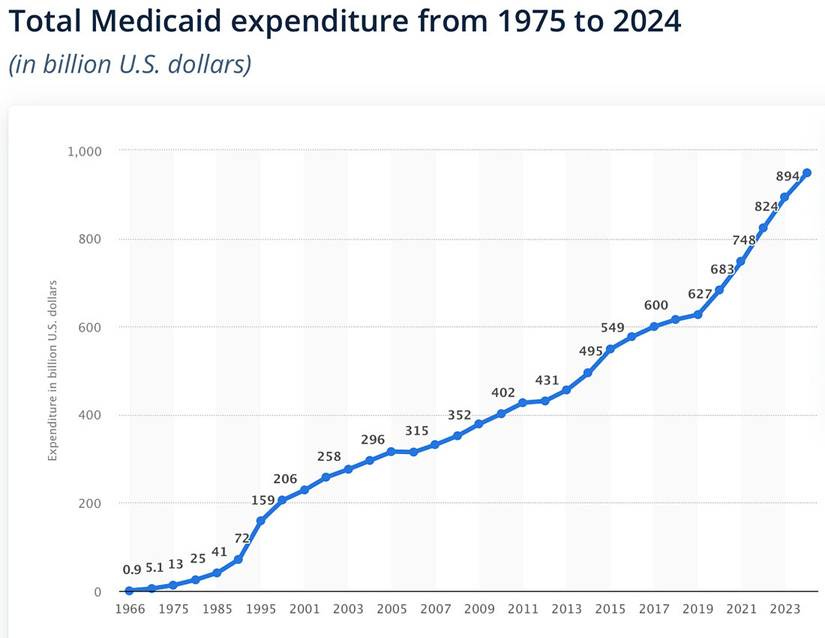
Yet, as we push the boundaries of science, it’s crucial to confront the shadows within our systems. A recent dialogue with Mehmet Oz shed light on the alarming fraud permeating Medicaid, orchestrated by organized crime across major U.S. cities. This revelation is a stark reminder of the financial hemorrhage affecting a system already burdened with nearly a trillion-dollar expenditure.
Intriguingly, Oz’s connection to Roger Altman, a recipient of a heart transplant performed by Oz himself, underscores the miraculous strides in medical science. Altman’s heart, much like Ted Gordon’s, has withstood the test of time, a testament to the advancements that now propel us into an era of unprecedented health innovations.
As we pivot towards the scientific intricacies that underpin these developments, it is clear that we are at the cusp of a new chapter—a chapter where the convergence of technology, biology, and human ingenuity holds the promise of not just a longer life, but a life lived with vitality and purpose.
For blog top part about 5 22 26 KING QA Coming Innovations in HealthCare and Stopping Digital Drain
A Question from a Reader:
Q: There’s so much going on in medical research these days it’s hard to keep up with the latest discoveries that promise to change the future of healthcare. What do you think are a couple of exciting innovations that are on the horizon?
Fredrick I., Gainesville, FL
My Answer to Fredrick: A: You’re right, there’s so much going on that holds promise for a healthier future for us all.
For example, in cancer research, scientists have discovered how to super-charge immune system T-cells. Published in Nature Communications (https://www.nature.com/articles/s41467-025-59310-3), the study explains how the researchers rewired T-cells’ mitochondria (the metabolic battery) by blocking a protein. That then made the T cells act more quickly and to precisely target cancer cells, knocking them out while sparing other tissue.
Another revolutionary approach to identifying and destroying cancer cells early on was recently published in Nature. It uses CRISPIR gene editing (https://www.nature.com/articles/s41586-026-10384-z) to distinguished tumor DNA from healthy DNA and selectively cut only the former—stopping the cancer cell in its tracts.
Then there’s the discovery from Harvard researchers (https://www.science.org/doi/10.1126/sciadv.adz8362) that allows them to implant engineered liver tissue into a mouse and grow what they call a “satellite liver”. The goal is to one day engineer a whole implantable liver that can take over the work of the failing organ in a human. This may eliminate the need for a hard-to-find liver donor and a full transplant—and it opens the door to doing this for all failing organs.
These kinds of amazing discoveries are reshaping healthcare, but to me the most exciting ones are those that help you prevent diseases from ever happening! And many are already in your control: You don’t have to wait to have powerful ways to prevent disease. Just check out the info in my book, The Great Age Reboot.
Now some things you can do:
Another Reason to Choose Fiber:
Greater Fiber Intake Reduces Mortality Risk In Patients With Hyperlipidemia, Patients with hyperlipidemia who consume more fiber appear to have a lower mortality risk. The research team “divided individuals into tertiles according to their daily fiber intake: no more than 11.4 g, 11.41 to 18.15 g, and more than 18.15 g.” (desired for women is over 25 gm a day and for men is 35gm a day) People “with greater dietary fiber intake had lower risks of both all-cause and CVD mortality. For every additional 10 g of fiber consumed each day, all-cause mortality risk was lower by 21%, and CVD mortality risk was lower by a relative 23%. In an analysis of the tertiles, individuals who ate more than 18.15 g of fiber per day, compared with intake below 11.4 g/day, had reduced risks of all-cause mortality by 31% and CVD mortality 39% ” Lipids in Health and Disease https://link.springer.com/article/10.1186/s12944-026-02961-y
Another Reason to Get Rid of Visceral Fat and Thin:
Abdominal Visceral Obesity Linked To Higher Prevalence, Greater Severity Of Menopausal Symptoms: Fat around your organs—what we call visceral fat is associated with a higher prevalence and greater severity of menopausal symptoms, according to a study in Menopause https://journals.lww.com/ menopausejournal/abstract/9900/ menopausal symptom_network_differences between.665.aspx The research team observed “that women with visceral fat reported a higher prevalence and greater severity of several symptoms:Forgetfulness, irritability, and night sweats.
The Take Homes:
1. Follow Liz Parrish at BIO Viva Science.com
2. Consider the Buck LongevityClinic’s conference Oct 17-18
3. D o speed of processing games see BrainHQ.com’s Freeze Frame and Double Decision
4. Get More Fiber
5. Get your visceral fat measured (we do it routinely at the Wellnes/Longevity Program at the Cleveland Clinic) and do whatever you need to get rid of it
Thanks for reading.
Mike Roizen MF, FACP